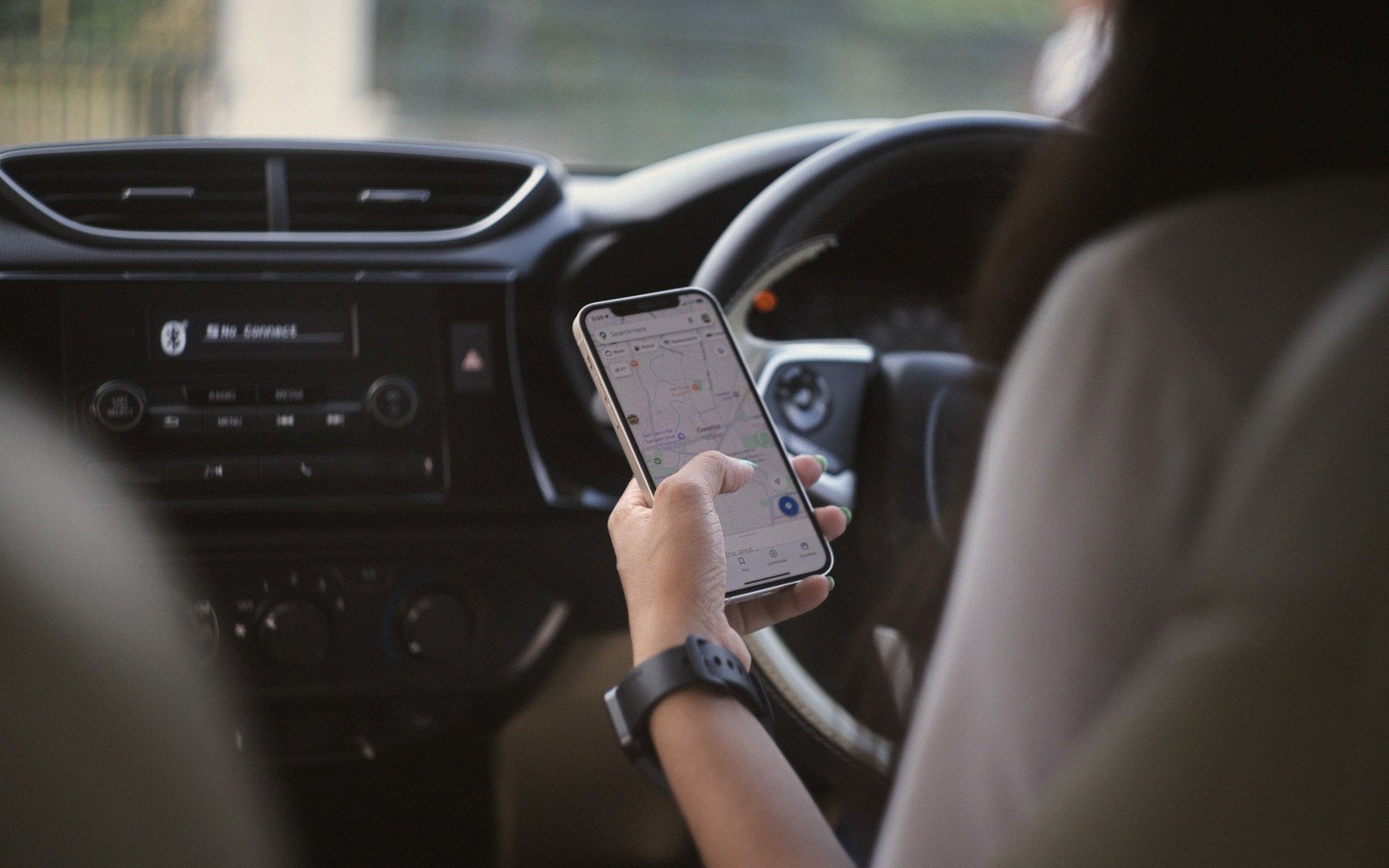
01 The distraction trap is real — and it works exactly like the one we already know
Here's something most drivers quietly resist believing: talking on a hands-free phone while driving impairs you about as much as talking on a handheld one. Researchers have replicated this finding repeatedly, and it runs counter to instinct. The hands are on the wheel, so surely that's the dangerous part sorted? It isn't. The danger lives in where your attention goes, not where your hands are.
That's the first thing worth understanding about phone-related distraction: it isn't really about the device. It's about cognitive load — the share of your brain's processing that the road stops receiving. When someone's telling you something involving on the other end of a call, your eyes may still be pointing forward, but your mind has partially left the car. Research calls this "inattention blindness": drivers in this state can look directly at a hazard and not consciously register it. A child at a crossing, a brake light ahead, a car pulling out — all of it can slide past unreacted-to.
02 What the impairment actually costs you
Slow reactions are the measurable cost. A driver travelling at 55 mph who glances at a phone screen for just five seconds covers roughly the length of a football field in that time — eyes completely off the road. Add in cognitive distraction on top of visual distraction, and the reaction-time deficit starts to look like what we see in drivers over the legal alcohol limit. The parallel is deliberate: road-safety researchers began making it explicitly in the early 2000s, when mobile phone ownership crossed into mass use and collision data started to reflect it.
That reaction-time gap is where crashes live. The distracted driver doesn't see the vehicle braking ahead until it's too late to stop cleanly. They miss the cyclist filtering up on the left. They don't catch the child stepping off the kerb because by the time the image registered, the car had already passed the moment of possible response. Minor incidents become fender-benders; fender-benders become serious collisions; serious collisions become the kind of night nobody recovers from in the normal sense of the word.
03 Practical habits that genuinely work
The good news — and there genuinely is good news here — is that this is one of the more solvable problems in road safety, because the fix is simple and free and you can start it before you reverse out of the driveway.
Phone away before the engine starts. Not on the passenger seat, not in the cupholder, not face-down on your lap. In a bag in the back, or in a glovebox. Even a cupholder is better than the seat, but physically out of reach is better still. Out of sight genuinely is closer to out of mind — the visual reminder of the device is part of what triggers the urge to check it.
Notifications off, or Do Not Disturb driving mode on. Both iOS and Android have had automatic driving modes for years. They suppress notifications and can auto-reply to messages. Using them costs you nothing except the mild inconvenience of setting them up once.
Pull over for anything genuinely urgent. If a call really can't wait, a car park or a safe stopping place takes ninety seconds to find and costs you nothing catastrophic. Whatever the message says, it will still say it when you're stopped.
Friends in the car can run point. Passenger gets the map, the playlist, the texts. The driver drives. This is one of the easiest and most underused ways a group makes the ride safer — the person who isn't steering takes everything that would otherwise compete for the driver's attention.
None of this is complicated. That's the point. The phone doesn't impair you the way alcohol does — it doesn't alter your chemistry or take away your judgment slowly over a long evening. It just grabs your attention, and attention is the whole job. Give the road all of it, every time, and this particular risk quietly disappears.